Customer Appreciation Drop · Pay What You Can
Orra Ducker
Per-frequency sidechain ducking
Most people use sidechain compression for ducking, which turns down your whole signal. Orra Ducker ducks only the frequencies that actually collide, keyed from any track, in any DAW. And with Orra Link, sidechain routing lives right in the plugin, so feeding several instances from different sources is the same simple workflow in every DAW.
Secure checkout by Lemon Squeezy
Duck the collision, not the whole signal
Per-frequency, not per-fader.
Orra Ducker runs an FFT on both signals and ducks each frequency only where the two actually overlap, so a kick can clear space inside a bass without dropping the whole bass line.
The Usual Routing
Running several duckers on one track, each keyed from a different source, is doable in some DAWs but fiddly, and the setup is different in every single one. Aux tracks, bus juggling, send routing, and a fresh fight with your host every time you switch.
Possible, but a different headache in every DAW.
The Orra Way
Orra Link takes the routing off your plate. Source selection lives right in the plugin, and each instance just picks its trigger from a dropdown, up to 37 sidechain sources feeding one track. No aux tracks, no bus juggling, and the exact same workflow no matter what DAW you are in.
One workflow. Identical in every DAW.
One track. One simple setup.
Each instance picks its trigger from a dropdown, no aux tracks, no bus juggling. Here is what that looks like in a session.
Instance 1, keyed to the kick
Reads Link 1. Carves a pocket in the low end every time the kick lands, leaving everything above it untouched.
Instance 2, keyed to the vocal
Reads Link 2. Pulls back the synth's mids only where the lead vocal sits, so the words stay forward.
Instance 3, keyed to the bass
Reads Link 3. Makes room in the low-mids where the bass and synth fight, and nowhere else.
Orra Link is a tiny sender-only plugin that ships alongside Orra Ducker. It broadcasts a track's audio onto a numbered channel in a shared bus that every Orra Flagship plugin in the project can read.
Drop it on any track or bus, pick a channel (Link 1 through Link 36), and that source becomes available as a trigger for any Orra Ducker instance in the project, even in hosts whose routing won't normally let you sidechain across busses.
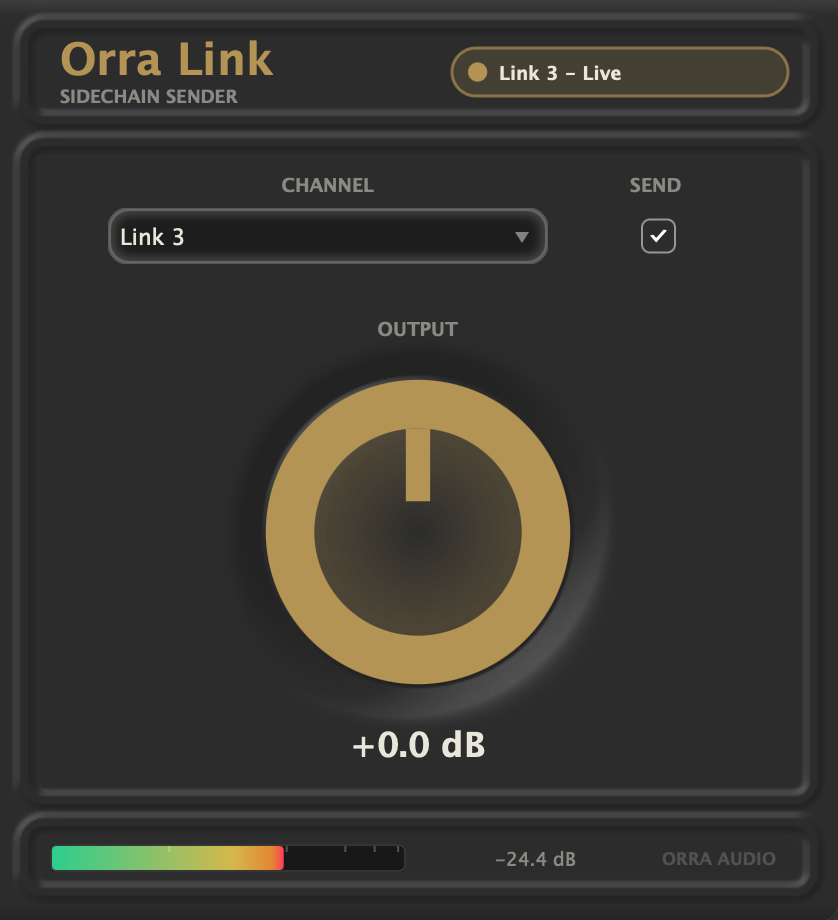
Orra Link
Sidechain Sender, Included
We don't know of another spectral ducker that lets you stack a separate instance per source on one track, in any DAW.
Under the hood
How it works, the analyzer, and the technical detail
Per-bin, not per-fader
A normal ducker measures one number from the sidechain, its overall level, and pulls down one fader. Orra Ducker runs a 2048-point FFT on both the trigger and your audio, splitting each into roughly a thousand frequency bins. Every bin gets its own detector and gain computer.
Only the bins that collide
A bin in your signal is ducked only when the matching bin in the sidechain crosses the threshold. That is why a kick can make space for itself inside a bass without dropping the whole bass line, only the bins the two share get touched.
Resolution is the carving tool
RESOLUTION sets how finely the per-bin reduction varies across frequency, surgical and narrow, or broad and smooth. It is the difference between a precise notch and a gentle tilt.
The Live exception
Live mode skips the FFT and runs a classic broadband envelope ducker, one detector, one gain, for zero-latency live monitoring. Every other mode is fully spectral.
Signal flow
Trigger source (None / External / Link) → per-bin detector → per-bin gain computer (Threshold, Ratio) → temporal smoothing (Attack, Release) → frequency smoothing (Resolution) → focus mask (Low / High Cut) → applied to your audio. Stereo detection is blended by the Link control before the gain computer.
Complete your toolkit
Orra EQ
16 bands of parametric EQ with per-band dynamic saturation and 17 saturation algorithms.
Explore Orra EQOrra Press
Six dynamics engines in six reorderable slots. Shares the same Orra Link sidechain system.
Explore Orra PressOrra Tone Zone
Free / pay-what-you-can. Target curve system, adaptive auto-correction, and 6-band EQ.
Try Tone Zone, FreeGet Orra Ducker
A Customer Appreciation drop. Pay what feels right, $5 and up. Orra Link is included.